
 en
 italiano
 čeština
 Deutsch
 français
 hrvatski
 magyar
 polski
 српски
 русский
 中文
 中文
 한국어
 español
Trimming entities
You can clip, or trim, entities so they end at one or more cutting edges defined by other entities. You can also trim entities to the point at which they would intersect an implied cutting edge. When trimming entities, you first select the cutting edges and then specify the entities to trim, selecting them either one at a time, using the fence selection method, or using the projection selection method.
You can trim lines, arcs, circles, two- and three-dimensional polylines, and rays. Lines, arcs, circles, polylines, splines, rays, infinite lines, layout viewports, and tables can act as cutting edges. An entity can be both a cutting edge and one of the entities being trimmed.
Use the Quick Trim command.
You can trim all entities to the edge of a cutting entity in a single operation. Choose the Quick Trim express tool or type extrim.
To trim an entity
1 Do one of the following to choose Trim ( ):
• Select Trim from the ribbon or the menu.
• On the Modify toolbar, click the Trim tool.
• Type trim and then press Enter.
2 Select one or more entities that you want to use as cutting edges, and then press Enter. This step is required only if mOde in the next prompt is set to Standard; if set to Quick, all entities are automatically considered as cutting edges.
3 Select the entity to trim.
4 Select another entity to trim, or press Enter to complete the command.
|
|
||
|
To trim entities, select the cutting edge (A), and then select the entities to trim (B). |
|
Result. |

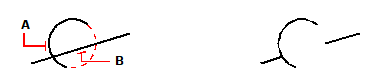
To trim an entity to an implied edge
1 Do one of the following to choose Trim ( ):
• Select Trim from the ribbon or the menu.
• On the Modify toolbar, click the Trim tool.
• Type trim and then press Enter.
2 Select one or more entities that you want to use as cutting edges, and then press Enter. This step is required only if mOde in the next prompt is set to Standard; if set to Quick, all entities are automatically considered as cutting edges.
3 Choose Edge Mode.
4 Choose Extend.
5 Select the entity to trim.
6 Select another entity to trim, or press Enter to complete the command.
|
|
||
|
Select the implied cutting edge (A), and then select the entities to trim (B). |
|
Result. |
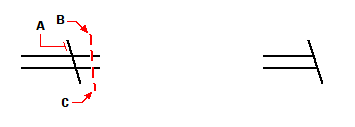
To trim several entities using the fence selection method
1 Do one of the following to choose Trim ( ):
• Select Trim from the ribbon or the menu.
• On the Modify toolbar, click the Trim tool.
• Type trim and then press Enter.
2 Select one or more entities that you want to use as cutting edges, and then press Enter. This step is required only if mOde in the next prompt is set to Standard; if set to Quick, all entities are automatically considered as cutting edges.
3 Choose Fence.
4 Specify the first point of the fence.
5 Specify the second point of the fence.
6 Specify the next fence point, or press Enter to complete the command.
|
|
||
|
Select the cutting edge (A), and then specify the first point (B) and second point (C) of the fence. |
|
Result. |
To trim several entities using projection
1 Do one of the following to choose Trim ( ):
• Select Trim from the ribbon or the menu.
• On the Modify toolbar, click the Trim tool.
• Type trim and then press Enter.
2 Select one or more entities that you want to use as cutting edges, and then press Enter. This step is required only if mOde in the next prompt is set to Standard; if set to Quick, all entities are automatically considered as cutting edges.
3 Choose Projection, and then choose one of the following at the prompt:
• None Trims only entities that intersect with the cutting edge in three dimensions.
• UCS Trims entities that intersect with the projection of the cutting edge onto the XY plane of the current UCS and not those that intersect with the cutting edge in three dimensions.
• View Trims entities that intersect with the projection of the cutting edge along the current view direction.
4 Select the entity to trim.
5 Select another entity to trim, or press Enter to complete the command.